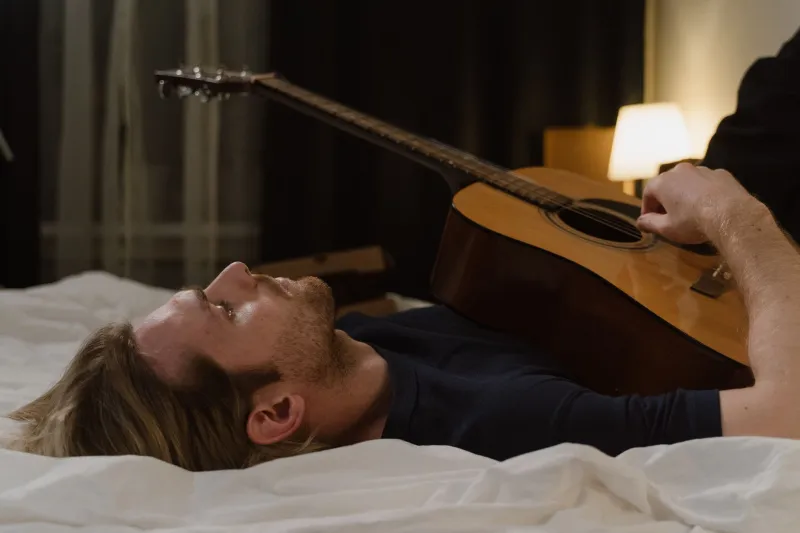
Cracking Open: How Showing Her Your Weak Spots Actually Makes You Unstoppable

Let's start with the thing nobody wants to say out loud: most guys are absolutely terrified of being seen as anything less than solid. Unshakeable. Put-together. And that fear? It's quietly killing their relationships, their sex lives, and their shot at anything real.
Here's the twist. The men who are genuinely magnetic — the ones women actually stay for, not just sleep with — aren't the ones with zero cracks. They're the ones who know which cracks to show, and when.
That's the vulnerability paradox. And once you understand it, you stop playing defense and start playing a completely different game.
Why We're Wired to Hide
Before you can flip the script, you've got to understand why the script exists in the first place.
American culture has spent decades selling men a very specific image: stoic, capable, unflappable. John Wayne. The strong silent type. The guy who fixes the problem without ever admitting there was one. It's baked into how we were raised, how we talk to each other, how we perform in relationships.
And look — some of that isn't useless. Stability is attractive. Groundedness matters. Nobody wants a partner who falls apart at every inconvenience.
But there's a massive difference between being genuinely grounded and performing invincibility. One is strength. The other is a mask. And women can smell the difference from across the room.
Psychologists have a name for the compulsive need to appear competent and in control at all times: self-concealment. Research out of the University of Michigan found that chronic self-concealment is directly linked to lower relationship satisfaction, higher anxiety, and — here's the kicker — less intimacy over time. You think hiding your mess keeps her close. It actually keeps her at arm's length.
The Science of Getting Real
Back in the 1960s, psychologist Sidney Jourard coined the term "self-disclosure" and spent years studying how openness between people creates connection. His conclusion was blunt: you cannot have real intimacy without real disclosure. Period.
More recently, Brené Brown's research at the University of Houston put vulnerability on the map for mainstream audiences. Her finding — that vulnerability is the birthplace of connection, creativity, and belonging — got millions of views on TED and turned into a cultural moment. But here's what got lost in translation for a lot of guys: Brown wasn't saying you should cry on the first date or unload your childhood trauma at happy hour. She was talking about courage. The willingness to be seen, on your own terms, without guaranteeing the outcome.
That distinction matters enormously.
Selective Vulnerability: The Part Nobody Talks About
Here's where most conversations about vulnerability go off the rails. They make it sound binary — either you're locked up tight or you're emotionally bleeding all over the place. Neither extreme works.
Selective vulnerability is the skill. It means knowing what to share, how much, and when — not as a strategy to seem deep, but as a genuine act of self-disclosure that invites connection without demanding it.
Some examples of vulnerability that builds attraction:
- Admitting you were nervous before a big moment in your life
- Sharing a failure you actually learned something from
- Saying "I don't have this figured out yet" about something real
- Telling her what scared you about getting close to someone again after a rough breakup
- Being honest that you care about how things go between you two
Notice what all of those have in common: they're honest, they're grounded in self-awareness, and they don't demand anything from her. You're not confessing to get reassurance. You're not dumping to get sympathy. You're opening a door and letting her choose to walk through it.
Now here's what undermines attraction masquerading as vulnerability:
- Constant self-deprecation that's really fishing for compliments
- Oversharing too early because you're anxious and can't hold back
- Using "I'm just being honest" as cover for emotional dumping
- Admitting insecurities and then immediately asking if she still likes you
- Turning every deep conversation into a therapy session where she's the therapist
The difference is intent and timing. Genuine vulnerability is offered freely. Anxious oversharing is a request for rescue. She knows which one she's getting.
What Actually Happens When You Let Her In
Talk to couples who've been together for years — not the ones putting on a show, but the ones who are actually solid — and a pattern emerges. Almost every one of them can point to a moment early on when the guy dropped the act. Not dramatically. Not performatively. Just... got real.
One guy described it like this: "We were maybe two months in and I told her I was genuinely scared of getting hurt again after my last relationship. I didn't ask her to fix it. I just said it. She told me later that was the moment she knew I was different from the other guys she'd dated."
That's not a coincidence. That's the vulnerability paradox in action. The moment he stopped performing strength and showed her actual courage — the courage to be honest without a safety net — something shifted. She stopped seeing a guy trying to impress her and started seeing a man she could actually trust.
Trust is the engine of real attraction. And you can't build trust with a mask on.
How to Start Without Faking It
If you've spent years in full armor, you don't flip this overnight. And you shouldn't try to. Forced vulnerability is just a different kind of performance — and it reads just as hollow.
Start small. The next time something doesn't go the way you planned, resist the urge to shrug it off or spin it. Just acknowledge it. "That didn't go how I expected. I'm figuring it out." That's it. No dramatics required.
Pay attention to how it lands. Real vulnerability invites reciprocity. When you get real, she tends to get real back. That's the signal you're doing it right — the conversation deepens instead of getting weird.
And if she uses your openness against you? That tells you something important about her, not about you. The right person doesn't weaponize your honesty. They meet it.
The Bottom Line
Being seen — actually seen, not just admired — is one of the most powerful things that can happen between two people. It's also one of the most uncomfortable. That discomfort is the price of admission for anything real.
The guys who get this aren't softer. They're actually harder in the ways that matter — secure enough in themselves that they don't need the armor. They've figured out that the strongest move isn't pretending nothing touches you. It's showing that some things do, and being okay with that.
That's not weakness. That's the whole game.